Receipt Hog: Cash for Receipts
- 4.7
- Rating
- 5.00M
- Installs
- Free
- Price

 Analysis by App-foxy
I like receipt-reward apps when they fit quietly into a shopping routine instead of turning every purchase into a chore. Receipt Hog: Cash for Receipts takes that approach: you submit receipts from everyday shopping and receive rewards through the app. It is a free shopping app from Numerator, LLC, available to Everyone, and its appeal is simple enough to understand immediately. My overall view is positive, but with an important qualification: this is best treated as a small, gradual reward for a habit you already have, not as a serious money-making tool.
That distinction matters. If you already keep receipts, checking them through this app can feel like a useful extra step. If you expect instant cash, large returns, or a completely automatic experience, the process may feel too slow. I found the strongest part of Receipt Hog is its low barrier to entry, while its main weakness is that the value depends heavily on consistency. The app rewards patience more than occasional bursts of activity.
How Receipt Hog fits into ordinary shopping
The basic workflow is easy to understand. After shopping online or in a physical store, I would keep the receipt, open the app, and submit it instead of letting it disappear into a wallet or recycling bin. That makes the service most useful when it becomes part of the same routine as unpacking groceries or reviewing a bank transaction. The less effort involved in remembering, the more practical the reward becomes.
You May Also Like

 Google Keep - Notes and lists
Google Keep’s Quiet Growth Shows the Appeal of Simpler Notes
As mobile work gets busier, Google Keep keeps winning a simple contest: capture a thought quickly, find it later, and get on with the day.

 Blood Strike: 2.5 Anniversary
Blood Strike’s Loadouts Turn Every Drop Into a Tactical Gamble
A close look at Blood Strike’s custom loadouts: how fast access to signature weapons reshapes its battle royale rhythm, rewards preparation, and narrows the gap between fights.

 Pandora - Music & Podcasts
Pandora’s Music Is Easy to Start, but Harder to Recover
Pandora’s strength is its low-effort path from a seed to a station. Its weak spot is how much confidence it asks you to place in connection, setup, and quiet recovery.

 8 Ball Pool
 Is Built on Rivalries, Rematches, and Routine
A close look at the rivalries, rematches, shared routines, and unanswered safety questions that turn a quick pool match into a persistent mobile community.

 Samsung Music
’s Quiet Strength Is Playing What You Already Own
Its reach comes less from spectacle than from dependable access to a personal library. That simplicity is both the app’s strongest retention engine and its ceiling.

 AccuWeather: Weather Radar
AccuWeather Review: A Quick, Clear Forecast for Everyday Decisions
For everyday plans, the best forecast is the one you can understand quickly. AccuWeather makes rain timing, radar, and local conditions easy to act on, with a few trade-offs.
More From Our News Desk



There is also a useful psychological advantage here: the app gives receipts a second purpose. Normally, a receipt is only valuable when I need to return something, check a charge, or compare spending later. With Receipt Hog, I have another reason to hold on to it briefly. That does not transform shopping into a profitable activity, but it can make a small amount of value from paperwork I would otherwise ignore.
The store summary describes rewards for purchases made online or in-store, which gives the app a wider role than a service limited to supermarket slips. In practice, I would still approach each receipt carefully and follow the submission flow rather than assuming every purchase will produce the same result. The useful habit is not “buy more to earn more”; it is “remember to submit the purchases you were already going to make.”
That difference is the key to using it responsibly. A receipt-reward app should never be a reason to spend extra money, split a purchase unnecessarily, or choose a more expensive retailer. The reward is an after-effect of shopping, not a discount applied before checkout. I consider that a strength because it keeps the concept straightforward, but it also limits how much the app can change a household budget.
The everyday scenario where it makes sense
Imagine finishing a weekly grocery trip with several receipts in your bag. Instead of throwing them away when you reach home, I would place them in one designated spot, open Receipt Hog after unpacking, and process them while the details are still easy to read. That small sequence is more reliable than trying to remember everything later. It also avoids the common problem of finding a faded or crumpled receipt days after the purchase.
For someone who shops regularly, this workflow can become almost automatic. The app does not need to dominate the day; it only needs a consistent moment in the day. I would choose one of three triggers: after groceries, after an online order arrives, or during a weekly receipt check. The best trigger is the one already connected to a routine, because relying on memory alone makes missed submissions much more likely.
One non-obvious tip is to separate “receipts to submit” from “receipts to keep for returns or warranties.” I would not discard an important receipt simply because it has been entered into the app. The reward workflow and the practical record-keeping function are different jobs. Keeping that distinction prevents an easy mistake: assuming a digital submission replaces the original proof of purchase when it may still be needed for another reason.
What the app’s reputation tells me
Receipt Hog has been available since July 12, 2013, and its current version is 9.1.0. It has passed five million installs, with an average rating of 4.6 from roughly 317,000 ratings and about 87,000 written reviews. Those figures suggest that the idea has remained relevant for a large audience over time, and the rating indicates that many users find the basic exchange worthwhile.
I would not treat popularity as proof that every user will enjoy it. Reward apps are unusually sensitive to personal habits: a frequent shopper who is organized with receipts will experience the service differently from someone who shops rarely or forgets to submit anything. Still, the long presence of the app and its broad adoption make it easier for me to view it as an established option rather than a novelty that depends entirely on a short-lived promotion.
The app is free, which removes the most obvious financial risk of trying it. That does not mean the time cost is zero. Every receipt requires attention, and attention is the real resource being exchanged. My advice is to test the routine for a short period and judge whether the process feels natural. If it becomes an irritating obligation, the reward is probably not compensating for the effort in your particular case.
Where the value is strongest
The best use case is a household with regular purchases, several people who can contribute receipts, and a simple system for collecting them. A family could keep a small envelope or tray for receipts, then process them together at a chosen time. The benefit is not just more opportunities to submit; it is fewer forgotten slips. The app works better when the household treats receipt collection as a shared routine rather than expecting one person to remember everything.
Another strong use case is the shopper who already reviews spending. If I am checking receipts against a bank statement or tracking grocery costs, submitting them at the same time adds little extra friction. This is more efficient than opening the app randomly throughout the week. Combining tasks is one of the clearest ways to protect the reward from becoming busywork.
Online shopping can also make the app relevant to people who do not carry paper receipts often. However, digital purchase records can be spread across email, retailer accounts, and order histories, so I would create a simple folder or label for them. The practical insight is to organize the evidence before opening the app. Searching through old messages every time would make the process feel much less rewarding.
I also appreciate that Receipt Hog is aimed at ordinary shopping rather than requiring a specialized hobby. A person does not need to be a coupon expert or master a complicated points strategy to understand the premise. That simplicity is valuable for users who want a modest benefit without learning a whole ecosystem of retailer-specific rules.
The trade-off between convenience and attention
The main limitation is that receipt rewards are rarely passive. The app can make the submission process feel manageable, but I still have to notice the receipt, preserve it, open the app, and complete the required steps. Any system based on user-submitted purchase records will have this friction. The more disorganized my shopping routine is, the less attractive the reward becomes.
Receipt quality is another practical concern. A receipt that is folded, wet, faded, or partly hidden can be harder to process than a clean one. I would submit receipts soon after shopping and place them flat if I knew I would not use the app immediately. This is a small habit, but it prevents the annoying situation of having a valid purchase record that is no longer easy to read.
There is also a trade-off between breadth and predictability. The app covers online and in-store purchases, which is convenient, but that does not mean every receipt feels equally straightforward. Different retailers produce different formats, and digital receipts may require more searching than paper ones. I would choose this app over a narrower alternative when variety matters more to me than having a highly specialized workflow.
Users should also keep expectations realistic about timing. The important benefit is the accumulation of rewards across repeated shopping, not a dramatic return from one receipt. Someone who wants an immediate discount at checkout may prefer a coupon or cash-back service connected directly to a retailer. Receipt Hog is better suited to people who are comfortable collecting small benefits after the purchase has already happened.
How it compares with familiar alternatives
Compared with store loyalty programs, Receipt Hog has a different role. A loyalty program may offer discounts or points at one retailer, while this app is more useful when I shop across different places and want one receipt-based routine. The trade-off is that a store program can feel more immediate at checkout, whereas Receipt Hog requires a separate submission step after buying.
Compared with coupon apps, it is less focused on planning a purchase before I make it. Coupons can influence what I buy and where I buy it; Receipt Hog fits better after the transaction. I would choose coupons when I am actively comparing prices, and I would use this app when I want to recover a little value from shopping decisions that are already made.
Compared with bank-linked cash-back services, a receipt-based system gives me more direct control over which purchase records I submit. That can be appealing to people who do not want every transaction connected automatically. The cost is manual work. If my priority is maximum convenience and automatic tracking, a bank-linked alternative may be a better fit. If I prefer a deliberate, receipt-by-receipt process, Receipt Hog makes more sense.
Receipt Hog also differs from survey-heavy reward apps. I would not choose it because I want lengthy questionnaires or frequent opinion tasks. Its appeal is tied to shopping evidence, so the experience feels more connected to something I have already done. On the other hand, a survey platform may give more ways to earn during periods when I have few receipts. That is an important exception for students, occasional shoppers, or anyone whose purchasing routine is limited.
Who should use it and who should skip it
I would recommend Receipt Hog to regular shoppers who can build a dependable receipt habit. It is especially suitable for people who shop at multiple retailers, already save receipts for personal records, or want a free way to turn routine purchases into gradual rewards. The Everyone age rating also makes it broadly approachable, although the practical value still depends on having eligible shopping activity to submit.
It is less suitable for people who rarely shop, immediately discard every receipt, or dislike manual reward tracking. I would also steer away from it if my main goal were instant savings, automatic cash back, or precise budgeting analytics. Those needs are better served by tools designed around checkout discounts, linked transactions, or expense categorization rather than receipt collection.
Before committing, I would ask myself three questions. Do I regularly receive receipts? Can I remember to submit them soon after shopping? Am I satisfied with a gradual reward instead of an immediate price reduction? If the answer is yes to all three, the app has a fair chance of becoming useful. If the answer is no, its free price will not eliminate the frustration of maintaining a habit that does not suit me.
My most practical recommendation is to start with a narrow routine rather than trying to process every old receipt at once. I would collect new receipts for one shopping cycle, submit them promptly, and notice how much effort the process takes. That test reveals more than the headline promise because it measures the real cost for my own schedule. It also prevents the common mistake of downloading several reward apps and creating a separate chore for each purchase.
My verdict after weighing the exchange
Receipt Hog: Cash for Receipts is a convincing option for a specific kind of user: someone who shops often, keeps records reasonably well, and enjoys small rewards that build over time. I like its clear concept, free entry, broad shopping context, and the way it can turn an otherwise disposable receipt into something worth handling. Its established history, current version 9.1.0, and strong user response reinforce the impression that the core idea has staying power.
At the same time, I would not oversell it. The app cannot make ordinary purchases profitable, and the manual receipt routine will feel unnecessary to people who want instant or automatic savings. Its real strength is consistency, not speed. The best results come from fitting Receipt Hog into a habit you already have, never from shopping more just to chase rewards.
For me, that makes it worth trying as a free addition to a normal shopping routine, especially when receipts are already being saved for budgeting or household records. I would recommend it to a friend with that expectation clearly stated: use it patiently, submit receipts while they are easy to access, and compare the effort with the reward honestly. If that exchange feels fair, Receipt Hog is a practical and approachable shopping companion; if not, a direct coupon or automatic cash-back service will probably be the better choice.
FAQs for Receipt Hog: Cash for Receipts
01What is Receipt Hog and how does it work?
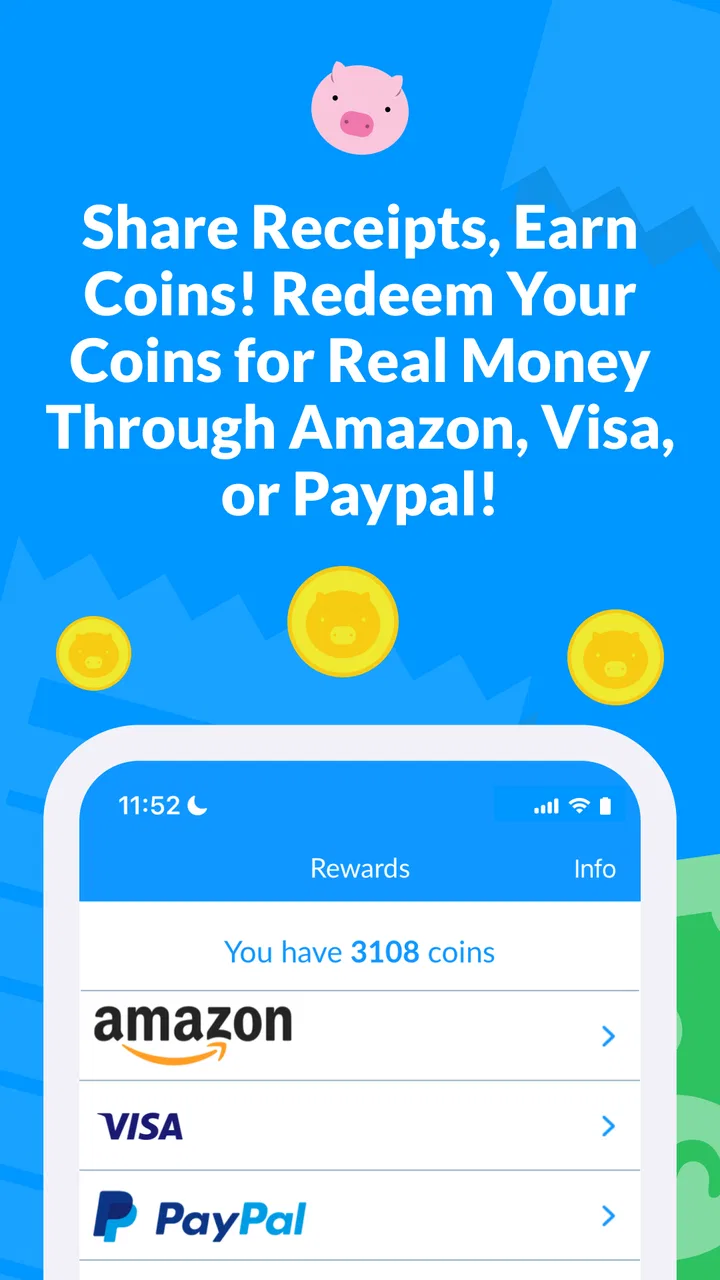
Receipt Hog is a mobile app that allows users to earn rewards by uploading receipts from their purchases. Simply take a photo of your receipt using the app, and you'll earn "coins" which can be redeemed for cash or gift cards. It's a fun way to turn your shopping into a rewarding experience.
02Is Receipt Hog available for both Android and iOS devices?
Yes, Receipt Hog is available for download on both Android and iOS platforms. Whether you use a smartphone or a tablet, you can enjoy the app's features and start earning rewards by uploading your shopping receipts. Just visit the Google Play Store or Apple App Store to download it.
03Are there any restrictions on the types of receipts I can upload?
Receipt Hog accepts a wide range of receipts, including those from grocery stores, restaurants, and pharmacies. However, there are some restrictions, such as the receipt must be from within the last two weeks. Be sure to check the app's guidelines to ensure your receipts qualify for rewards.
04How long does it take to process and verify receipts?
Receipt processing times can vary, but typically receipts are verified within a few days. Once your receipt is processed, you'll see the coins added to your account balance. Keep in mind that high-quality images of receipts can speed up the verification process.
05Is it safe to upload my receipts to Receipt Hog?
Yes, Receipt Hog is designed with user privacy and security in mind. The app does not store any sensitive personal information from your receipts, and it uses encryption to protect your data. You can use the app with confidence knowing your information is secure.
Pros
- Easy receipt scanning process.
- Supports multiple retailers and stores.
- Earns cash rewards consistently.
- User-friendly interface design.
- No hidden fees or charges.
Cons
- Limited reward options available.
- Slow customer service response.
- Requires internet connection.
- Occasional app crashes reported.
- Points expire if inactive.

Receipt Hog: Cash for Receipts
Gallery